

TAX STRATEGY
JOHOR CORPORATION TAX STRATEGY
Our Tax Strategy establishes our commitment to responsible, transparent, and compliant tax practices for the financial year ending 31 December 2025. It integrates tax governance with our business strategy, risk management, and sustainable value creation.
- Our strategy applies to our directors, employees, and relevant stakeholders. Our Tax Department administers its implementation, and the strategy is reviewed at least annually.
- We require commercially justified structures and reject arrangements designed solely to obtain tax advantages. We use tax incentives appropriately and apply Economic Co-operation and Development (OECD) guidelines and the arm’s-length principle in our transfer pricing practices.
- We review tax risks systematically, report them quarterly, and escalate significant matters. Our engagement with tax authorities emphasises timely compliance, openness, and constructive resolution.
INTRODUCTION
Johor Corporation (JCorp) was incorporated under the Johor Corporation Enactment, 1968 (as amended by the Johor Corporation Enactment, 1995) as a development agency and public enterprise.
JCorp's diverse operations encompass strategic investments in four key sectors, namely Agribusiness, Wellness & Healthcare, Food & Restaurants, and Real Estate & Infrastructure, facilitated through its flagship companies: Kulim (Malaysia) Berhad, KPJ Healthcare Berhad, QSR Brands (M) Holdings Bhd and JLand Group Sdn Bhd, respectively.
Entrusted with the mandate to evolve, invest, and innovate, JCorp actively prioritizes community development and environmental stewardship, fulfilling its role as a responsible corporate citizen. This commitment is reflected in JCorp’s purpose of “Membina & Membela” (Creating Value, Enabling Sustainable Communities), reinforced by a robust ESG-focused investment management strategy, in alignment with the state’s strategic vision, and effectively anchored by the Maju Johor 2030 plan.
Taxation forms an integral part of JCorp’s Governance Framework. JCorp adopts a responsible, transparent, and well-governed approach to tax practices, consistent with its commitment to integrity, accountability, and sustainable value creation.
SCOPE AND APPROACH TO TAX
Ensuring Compliance and Integrity in Tax Practices for a Sustainable Future
This Tax Strategy has been prepared in accordance with the requirements of the Global Reporting Initiative (“GRI”) 207 and Bursa’s Tax Governance Guide, and it is closely aligned with JCorp’s overall business strategy and commercial objectives, ensuring tax considerations are effectively integrated into key decision-making processes and operations. It represents JCorp’s overarching approach, key tax principles, governance/risk management practices employed in overseeing tax matters, addressing risks, and ensuring comprehensive compliance in line with the applicable tax regulations for financial year ending 31 December 2025.
The Board Audit and Risk Committee reviews and endorsed the Tax Strategy, and it is subsequently approved by the Members of JCorp with oversight mechanisms in place to ensure its effective implementation. The Tax Strategy shall be reviewed at least annually or as and when there are changes in strategy, regulatory requirements, operational needs, or organisational functions. Any amendments or updates should be approved accordingly by the Members of JCorp.
The Tax Department is responsible for the administration, interpretation, and enforcement of this Tax Strategy. The administration will encompass, among other things, the development of relevant Standard Operating Procedures (SOPs) to facilitate the effective implementation of this Tax Strategy.
JCorp’s Tax Strategy applies to all directors, employees and relevant stakeholders , with a focus on Tax Department, with compliance being routinely monitored. This strategy is enforced and implemented in accordance with JCorp’s Code of Conduct, the strategic goals set forth in the JCorp 3.0 Reinvention Plan, and JCorp’s corporate values embodied by the E.R.T.I framework.
FUNDAMENTAL TAX PRINCIPLES
JCorp is dedicated to managing its tax affairs in line with the following fundamental principles, which are consistent with JCorp's core values, business operations and the overarching sustainability framework:
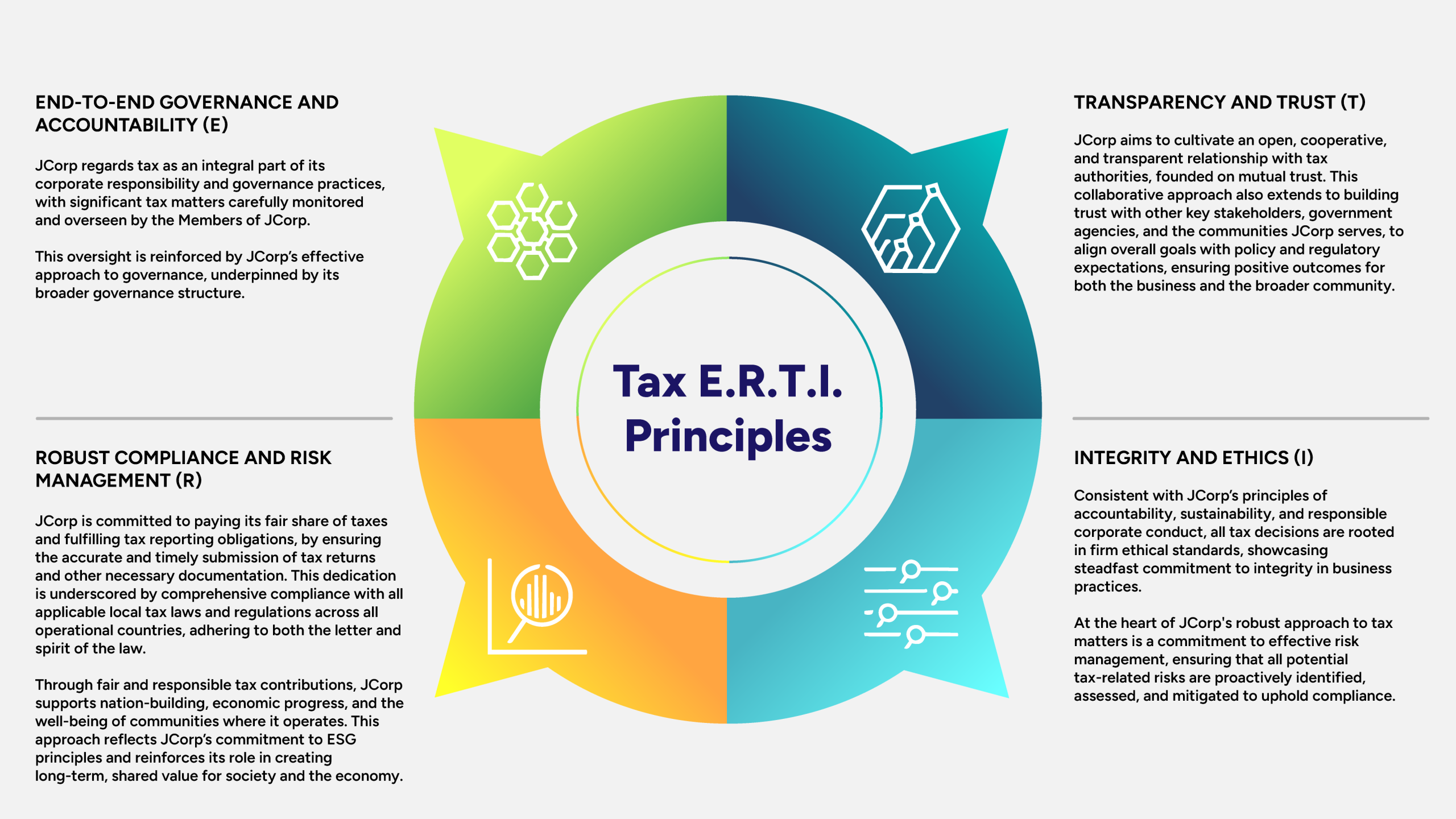
GOVERNANCE AND OVERSIGHT
JCorp's tax governance measures are effectively structured to ensure accountability, compliance, and transparency in all tax matters in accordance with the Tax E.R.T.I. principles as described in Section 3. The Members of JCorp, acting through the Management Committee, bears the ultimate responsibility for supervising JCorp’s tax affairs, and entrusts the daily management of tax operations to JCorp’s Tax Department.
With a team of skilled, experienced, and qualified tax professionals, JCorp's Tax manages tax matters, ensuring key tax requirements are duly considered in business transactions, investment decisions, regulatory requirements and aligned with the broader strategic, commercial, and operational objectives. This integrated approach adopted to uphold robust tax compliance, is further reinforced by the following measures:
i. Oversight of the Tax Strategy and prompt escalation of significant tax matters, in alignment with JCorp’s structured governance framework, as detailed in Figure 2 below.
ii. Proactive engagement with the Business, Operations, and Finance departments, to ensure a high level of awareness regarding tax-related requirements and reporting obligations. This includes:
- Providing advice and input on the formulation and documentation of tax positions, ensuring it is grounded in accurate legal interpretation and considered together with the practices/views of tax authorities.
- Offering insights and direction on the relevant tax implications and considerations associated with new investments, projects or business proposals.
iii. Partnering with JCorp’s Group Governance and Risk Division to identify, assess and manage tax risks in accordance with the relevant tax regulations, with further details on tax risk management outlined in Section 6.
iv. Proficiency and competency in tax matters, facilitated by regular training and knowledge-sharing initiatives to equip the team with tax knowledge and expertise, in line with the evolving tax developments and updates.

ATTITUDE TOWARD TAX PLANNING
JCorp considers tax planning an integral part of its broader commitment to ethical business practices, demonstrating its dedication to good governance and sustainable corporate growth principles.
i. Employing a principled approach, JCorp’s tax planning efforts comply with relevant tax laws and the broader public policy underpinning tax regulations, embodying its values of accountability, transparency, and responsible corporate conduct.
ii. JCorp upholds efficient business structures, guided by the Group's overarching goals and strategic priorities, with careful consideration of the related tax requirements. This entails:
- Ensuring business structures are substantiated by genuine substance and driven by commercial objectives, addressing both immediate and long-term corporate requirements.
- Refraining from entering arrangements designed solely to secure a tax advantage, which lack commercial justification and contradict the reasonable intent of applicable tax laws.
iii. JCorp endeavours to manage its tax positions effectively, maintaining a balance between business needs, responsible governance, whilst adhering to regulatory standards. In line with this approach, JCorp judiciously leverages available tax incentives and reliefs to optimise tax costs, aligning with the policy objectives set by regulators and supported accordingly by appropriate documentation.
iv. Following Organisation for Economic Co-operation and Development (OECD), guidelines and established transfer pricing rules, transactions between JCorp Group entities are executed at arm's length, representing the economic reality of each transaction.
MANAGEMENT OF TAX RISK
At JCorp, tax risk management is focused on diligent supervision, ensuring effective alignment with the fundamental tax principles detailed in Section 3. This approach is further anchored on JCorp’s comprehensive Enterprise Risk Management Policy and Framework and Limits of Authority , which promote a resilient risk management culture through oversight, systems, and processes.
Tax risks are systematically identified and reviewed based on applicable tax laws and emerging legislative developments , with quarterly reports detailing the potential impact, likelihood, and remediation strategies. Significant tax matters are escalated according to the governance structure illustrated in Figure 2, with guidance and approval sought from the Board Audit and Risk Committee and Members of JCorp, as required.
These measures are further supplemented by regular updates from external tax advisors, actively engaging with professional bodies and tax authorities, and participating in industry seminars and conferences. Key tax updates and relevant information are promptly conveyed to the management and relevant departments, fostering a culture of transparency and facilitating timely, well-informed decision-making.
While JCorp strives to ensure all tax positions comply with the requirements of pertinent tax laws and regulations, there may be occasions where it differs from treatment (or likely treatment) of the tax authorities. Such differences are arrived at with sufficient diligence and technical backing to ensure the relevance and reasonableness of the position. In such situations, JCorp is committed to collaborating constructively with tax authorities to resolve these matters, where necessary.
1.0 RELATIONSHIP AND ENGAGEMENT WITH TAX AUTHORITIES
JCorp's engagement and interactions with tax authorities are defined by effective collaboration, openness, and transparency.
Consistent with JCorp's Tax E.R.T.I. principles detailed in Section 3, JCorp is committed to fulfilling all statutory tax obligations in a timely and accurate manner. This commitment extends to promptly addressing regulatory inquiries, where JCorp endeavours to provide clear explanations and necessary supporting documentation, thereby facilitating an effective and streamlined review process.
In building a cooperative and constructive relationship with tax authorities, JCorp seeks to engage in open dialogue to effectively resolve issues, discuss interpretations of relevant tax laws, and clarify technical positions when appropriate. All correspondence and communications, regardless of complexity, are managed professionally and courteously, reflecting JCorp’s broader dedication to responsible governance, compliance, and integrity.